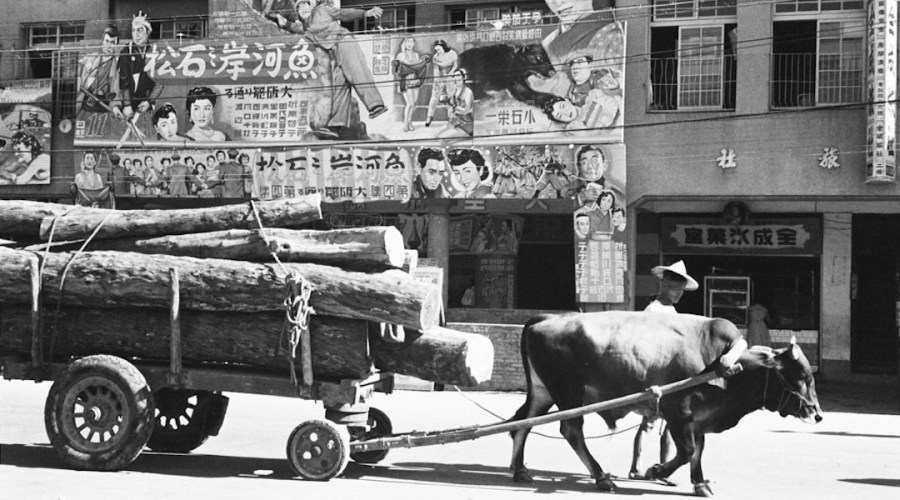
Based on Robert Wade, Governing the Market (Princeton, 1990), and Douglas Irwin, “How Economic Ideas Led to Taiwan’s Shift to Export Promotion in the 1950s,” working paper, 2021, Peterson Institute for International Economics
Early in the twentieth century, Korea and Taiwan were agricultural countries colonized and exploited by Japan. By the end of the century, they had become economic powerhouses set to overtake their former colonial master. The governments of both countries engaged in “industrial policy,” actively supporting the sectors that they believed had the most potential, but they implemented this policy in contrasting ways. Korea’s government relied heavily on powerful business groups, often making deals with individual groups. Taiwan was primarily a small business economy. Its business groups were much less powerful, and the government tended to support sectors rather than businesses or business groups. The Korean economy emphasized economies of scale; the Taiwanese economy did not. Korea sought technological self-sufficiency; Taiwan encouraged technology transfer through joint ventures with foreign firms. It seems that in the late twentieth century, the path to prosperity was not a narrow one.
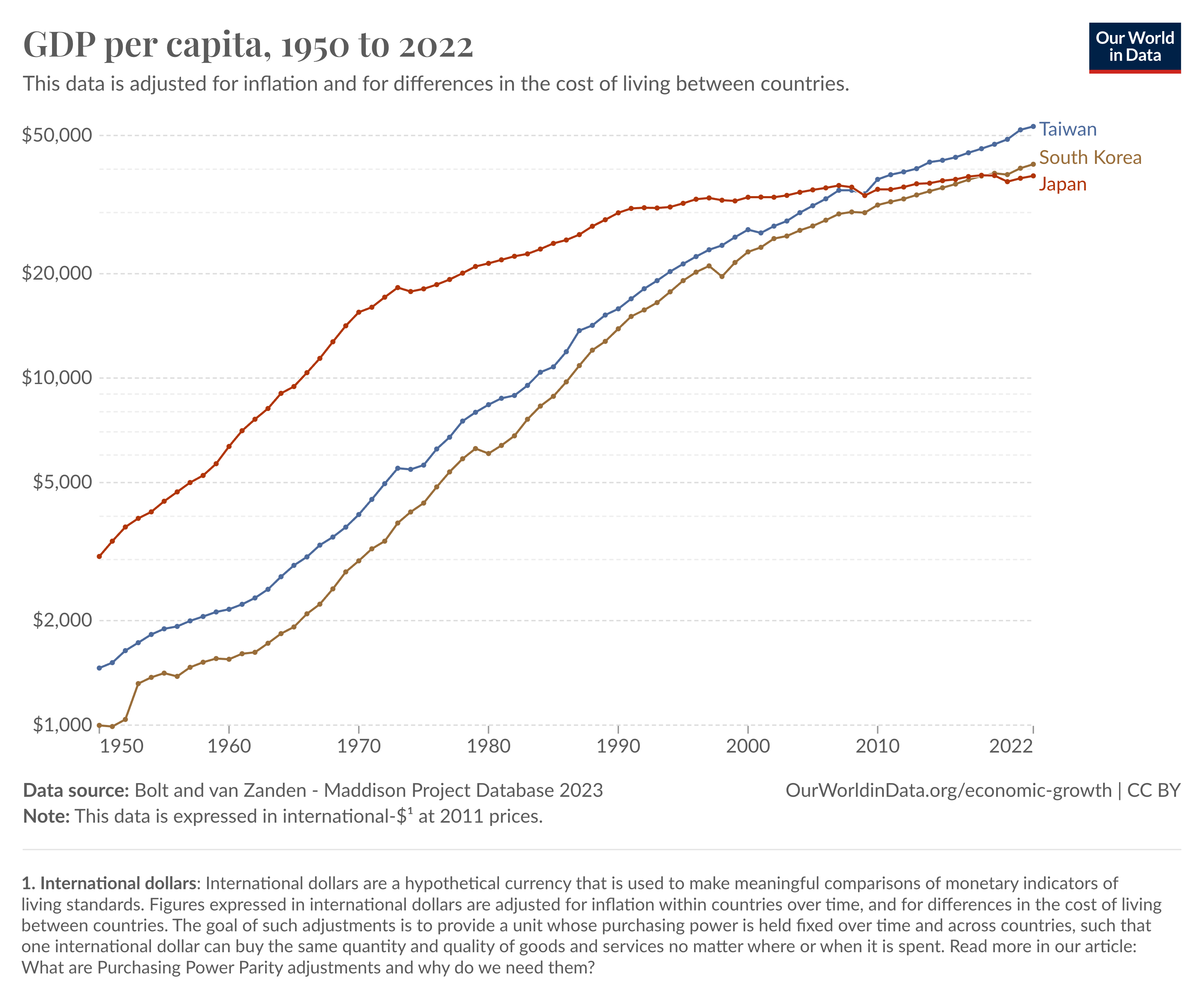
The previous post (here) outlined Korea’s path to economic growth; this post examines Taiwan’s complementary path.
Taiwan under Japanese Control
The peace treaty that ended the First Sino-Japanese War (1894-5) awarded Taiwan to Japan. Taiwan was at that time a province of China, poorly developed and governed by apathetic bureaucrats. Most of the people were Han settlers who farmed, with rice being the principal crop. Indigenous persons constituted about 3% of the population: they sometimes clashed with the settlers and did not recognize the Chinese government’s legitimacy.
Neither faction was prepared to accept a Japanese colonial government. The Japanese used force to establish their authority — more than twenty thousand Taiwanese were killed.
By the 1900s, the police had eliminated organized resistance among the Chinese…Unable to subdue the aborigines at first, the police adopted a containment policy, isolating them in the central mountain ranges. In 1910, after the government was firmly established, the police initiated a five-year pacification campaign.1
Close police surveillance continued after the island’s pacification. In the countryside, households were formed into groups of ten called chia, and the chia were formed into groups of ten called pia. Each group was jointly responsible for the behaviour of its members, and the entire system was overseen by the police. As well as maintaining order, the police “supervised tax collection, enforced sanitary measures, and even occasionally performed agricultural extension services.”2 The urban areas were regimented in a similar fashion. The police were the people’s main point of contact with the government.
Japan was primarily interested in Taiwan as a source of two crops, rice and sugar, both of which were needed in the homeland. The colonial government implemented policies to expand their production, benefiting the Taiwanese farmers as much as the Japanese consumer. The income per capita generated in the agricultural sector almost doubled over the half-century of Japanese rule.3
The Taiwanese system of land ownership involved three classes: great landlords who owned the land, tenant landlords who held the perpetual right to rent the land on fixed terms, and farmers who rented plots of land from the tenant landlords on less secure terms. The complexity of the system gave rise to numerous disputes over land transactions and tax obligations. The colonial government simplified the system by buying out the great landlords and assigning ownership of the land to the tenant landlords. They also restricted the form of the tenancy contracts in ways that encouraged land improvements and made the farmers’ tenancy more secure.
The government invested heavily in infrastructure: irrigation and flood control to increase productivity; railroads and port facilities to carry away the produce. It also invested in agricultural research facilities.
For an underdeveloped and colonial economy, the government was unusually research oriented. New techniques of cultivation, new varieties of seeds, and new methods of applying non-traditional agricultural inputs such as chemical fertilizer were developed, experimented with, and made available to the farmers…The pao-chia system was a particularly useful instrument for disseminating agricultural information.4
The government also acted in the realm of social welfare. Its initiatives on health and sanitation led to a sharp decline in the death rate and a doubling of the population. On the other hand, its education policies were restrictive until the 1930s. Taiwanese could attend primary school, and move from primary school to vocational training, but were generally excluded from further academic training.
The government was reluctant to provide education to a large segment of the population because it was aware of the inherent danger to its own existence of a discontented, educated population. Its decision to limit higher education to a small select group of Taiwanese was a device to keep the political and economic control of the island in Japanese hands. Only as tension between China and Japan grew in the 1930s and the government felt the need to assimilate the Taiwanese did it reverse its educational policy.5
The 1930s were also a turning point in the colonial government’s economic planning. Japan was now preparing for war, and needed Taiwan to become less reliant on Japanese exports. It was decided that Taiwan would build its own industry. Taiwan would satisfy more of its own needs, export some essential goods to Japan, and sell manufactures to south-east Asian countries. South-east Asia would also be a source of raw materials for Taiwan’s industry. To this end, the Japan Aluminum Company was established in 1935 — its bauxite came from Indonesia. Facilities for the production of iron, steel, and ferro-magnesium followed, and a number of light industries were set up. But the plan as a whole had limited success. The railroads and port facilities had been designed to carry away Taiwan’s agricultural surpluses and had little spare capacity. The restrictive education policies had prevented the development of a pool of skilled workers, so the new industries struggled to find the workers that they needed. The bottlenecks in transport and labour would not ease until the 1940s.
Matters were set up very well for the Nationalist Party, though, when it left the mainland for Taiwan. A military government replaced the colonial government; martial law (lasting until 1987) replaced police surveillance; a government with socialist leanings inherited the colonial government’s industrial core.
The Nationalist Party
China’s Qing dynasty, founded in 1644, was driven from power in 1911. China was then briefly ruled by a military junta led by Yuan Shikai, but after his death in 1916, China fragmented and the era of regional warlords began.
The first Nationalist Party (also known as the Kuomintang or KMT) was formed in 1912. It won the majority of the seats in China’s new National Assembly, but it could not prevent Yuan’s usurpation of power. Yuan dissolved the party and drove many of its members into exile. Sun Yat-sen, the party’s first leader, formed a new Nationalist Party in 1919. It established itself in Canton (now Guangzhou) and formed a provisional national government. This government controlled so little of China’s territory that Western powers refused to recognize it.
The party adhered to Sun Yat-sen’s political philosophy even after his death in 1925. Sun based his economic vision on his study of historical events such as the Meiji Restoration and Russia’s New Economic Policy. He believed that China should aspire to
… a form of society—a blend of private and public property, of market and government guidance—which…[he believed] the advanced countries were themselves moving toward.6
But China could not be reformed if it remained weak and divided. This recognition led Sun to adopt Lenin’s position that revolution must be initiated by a committed vanguard.
The overwhelmingly important task was to throw off the yoke of foreign powers and restore China to her former greatness in the ranks of nations. This could only be done by government direction, all the more so because nationalism had become so weak under the impact of foreign control that, as Sun Yat-sen said, the four hundred million Chinese had become like a wash of sand. Weak nationalism had to be compensated by a leviathan state…Some argued for tutelage under an enlightened despot (not a term of abuse), while others preferred a dictatorship by a vanguard party. Sun Yat-sen was the leading proponent of the latter, and as leader of the party as well as its chief theoretician, his view prevailed. The ideology of the Nationalist party thus had the idea of a vanguard party and the imperative of nationalism at its center from the beginning.7
It was in this context, and not out of any communist sympathies, that the Nationalist Party invited Russian advisors into the country. Indeed, the Nationalist Party would soon become fiercely anti-communist.
General Chiang Kai-Shek, the leader of the Nationalist army, took control of both the party and the government apparatus after Sun’s death in 1925. The party under his leadership became a war machine.
From 1926 to 1949 the party and its army held control over a fluctuating part of China, war being constantly fought on the boundaries—first against the warlords, then against the communists, then against the Japanese, then against the communists.8
The Nationalist Party, with its army always in the field, developed a strong military ethos. Chiang Kai-Shek’s position as chairman of the party and president of China came to be seen as a natural consequence of his position atop the military hierarchy. He would retain all of these positions until his death in Taiwan in 1975.
Japan was required to withdraw from Taiwan at the end of World War II. Its withdrawal left the country without a political culture, and with a severe shortage of administrative and managerial personnel. At the same time, the Nationalists were being routed by Mao’s armies. The Nationalists must have felt as if they were a round peg that would fit neatly into Taiwan’s round hole. The Nationalist government and its adherents, numbering between one and two million soldiers and civilians, fled to Taiwan in 1949.
The mainlanders and the islanders did not easily meld, and the distinction between the groups remained strong decades after the mainlanders’ arrival.
A 1970 survey found that 97 percent of the three best friends reported by native Taiwanese respondents were also native Taiwanese while, more surprisingly in view of their small numbers, 87 percent of the three best friends reported by mainlanders were mainlanders.9
One issue was that Taiwan, through long isolation from the mainland, had developed its own dialect. Few islanders could speak Mandarin, China’s national language, and very few mainlanders could speak the Taiwanese dialect. Another issue was that the mainlanders, by replacing the “missing” administrators and managers, quickly became an elite: “The native-born found themselves elbowed aside in government appointments, business, and housing, despite their three or four to one majority.”10 Yet another issue was the dissonance created by the Nationalists’ claim to be the rightful rulers of China. The claim legitimized the Nationalists’ rule of Taiwan, but it also prevented the islanders from being fairly represented in their own government: the “rightful government of all of China” could not be “dominated by people from one small province.”11
Agriculture and the Rural Economy
The Nationalists were well aware that the islanders regarded them as interlopers. Their best hope of reconciliation lay in improving the living conditions of the peasants that constituted the bulk of the islander population. They reformed agriculture in three steps, beginning with a dramatic reduction in rents, which had previously been as high as 70% of the harvest of the main crop.12
In early 1949, farm rent was limited to a maximum of 37.5% of the total main crop yield…In June 1951, public land formerly owned by Japanese nationals was distributed on easy terms, with preference given to the tenant claimants…In 1953, landlords were obliged to divest themselves of their holdings above a minimal size and sell out to their tenants under the Land-to-the-Tiller Act…Landlords were given land bonds in kind and stocks in public enterprise in exchange for the compulsory divestiture of their holdings. Some landlords profited from their stock ownership and became successful industrialists. Others went into bankruptcy. The landlord class, however, sank into social oblivion.13
As in South Korea, the elimination of the landlord class created a more equal distribution of income, allowing the government to focus on economic growth to the near exclusion of redistributive issues.
The Nationalists’ agricultural policy initially took the form of “primitive socialist accumulation” — the extraction of surplus from the agricultural sector to finance industrialization.
[The state’s] monopoly over fertilizers made every peasant…beholden to the state.14
The barter of fertilizer for rice was…the major mechanism for transferring surplus out of the countryside. Over half the rice collected by the government in the 1950s and 1960s resulted from this barter arrangement. The barter ratio was highly unfavorable to farmers. The price which Taiwanese farmers paid for 100 kilograms of ammonium sulphate in 1964-65 was higher by almost 40% than the price which Japanese, Dutch, Belgian, American or Indian farmers paid.
Other mechanisms were also used to transfer real net surplus out of agriculture: land taxes, compulsory rice purchases by the government, loan repayments and repayment for land resold to tenants under “land-to-the-tiller.” All such collections were made in kind. All amounted to “hidden rice taxes” because the government’s purchase prices were considerably lower than implicit market prices. Together, such collections brought more than half of the marketed surplus of rice into government hands after the war. About half the rice collected by the government was rationed to the military and civil servants, including teachers and their dependents; 20% was sold on the free market for revenue and price stabilization purposes; the remaining 30% was exported. The government’s gains through rice collection were enormous. The hidden rice tax exceeded total income-tax revenue every year before 1963.15
As well, the country’s foreign exchange policies — an overvalued domestic currency coupled with tariffs and import quotas — implicitly transferred resources from the agricultural sector to the industrial sector.
Exports, which were mostly agricultural, received less in domestic currency than they would have at an equilibrium exchange rate, so the overvalued rate acted as a kind of export tax…The trade controls which accompanied the overvalued exchange rate increased the price of daily consumer goods, tending to lower agriculturalists’ real income. On the other hand, industrialists benefited from the overvalued exchange rate in the form of lower costs of imported inputs, and benefited from the trade controls through higher prices for products sold on the domestic market.16
Rural incomes rose in spite of this transfer of surplus. Farms adopted new methods and better equipment, switched to higher-value crops, or switched from growing crops to raising livestock.
Taiwan’s early industrialization had taken place in the cities, but in the late 1950s, the growth of nonagricultural employment in rural areas began to outpace the growth of urban employment. Several factors contributed to this shift. The farmers’ higher incomes gave rise to a demand for simple consumer goods like electric fans, bicycles, and radios, and the improvements in farming technology gave rise to a demand for new farm inputs. Local entrepreneurs started businesses to meet these demands. Food processing plants also set up in the countryside, so that they would be near to their food sources. As well, “some of the fastest growing industries” of the 1960s — including textiles, clothing, and electronics — “located in rural areas to tap the large reserve of low-cost women workers scattered in the countryside.”17
Taiwan’s rural production plants tended to be small. In 1961, more than 96% of them either employed fewer than 20 people and used power, or employed fewer than 40 people and used no power. Nevertheless, in the same year, the largest plants (those having more than 100 workers) accounted for more than one-third of rural manufacturing employment.18
The industrialization of rural areas meant that rural households became less and less dependent on farming for their incomes. In 1960, 52% of rural households earned some income from activities other than farming, and of these households, 43% earned most of their income from these activities.19 The share of rural households earning nonfarm income rose over time, reaching 91% by 1980.20
Young people often left the rural areas in search of better opportunities in the cities and towns, so the number of farmers fell and their average age rose. By the early 1970s, there was a shortage of farm labour. The state, prioritizing self-sufficiency in rice (as Japan was doing at the same time), switched from taxing the agricultural sector to subsiding it. The rice-for-fertilizer barter program was abolished in 1973. The government’s procurement price for rice, which had previously been about 70-80% of the free market price, was stabilized at a level above the free market price.21
Industry
The Nationalist government took over the industrial properties developed by the Japanese. These properties comprised
…494 major enterprises in heavy industry and 484 minor ones in light industry. Major enterprises instantly became state-owned enterprises, while minor enterprises were auctioned off.22
The retention of the major enterprises was in line with Sun Yat-sen’s conviction that the government should guide the economy. Public enterprises accounted for more than half of Taiwan’s industrial production throughout the 1950s.23
The Taiwanese economy relied on American aid during the 1950s, and it was the influence of American aid officials that prevented a further expansion of public enterprise.
Over the 1950s [American] economic aid equaled about 6 percent of GNP and nearly 40 percent of gross investment, and military aid was bigger still. The biggest share of economic aid, 38 percent, went to finance imports of intermediate goods (mainly cotton, yarn, ores, metals, and fertilizer); 30 percent went for consumer goods (mainly food); another 19 percent went for capital goods (machinery and tools).24
U.S. advisors used their aid leverage to check the hostility that Nationalist officials had shown toward private business on the mainland, and to exert pressure at the margin in favor of using aid for creating or helping private firms. U.S. officials themselves sought out private investors for new projects (as in plastics, rayon, and glass), and in several instances blocked attempts by the Nationalist government to put projects under public ownership…The first plastics plant in 1957 was a key battle; many hardliners in the Nationalist party fought to have it as a public enterprise, and their defeat marked a turning point in acceptance within large parts of government that new industries, even if in some sense strategic for the rest of the economy, did not have to be located in the public sector.25
The public enterprises’ share of industrial output slowly fell after the 1950s, mostly due to the expansion of the private sector. It was less than 20% by the early 1970s. The state’s share of domestic investment also fell, from a high of 60% in 1958 to 40% in 1972.26
Small businesses dominated the industrial sector.
Only 176 firms in Taiwan had more than 1,000 employees in 1976 (including public as well as private, foreign as well as domestic firms). Over 80 percent of firms had fewer than 20 employees.27
Taiwanese firms were also much less likely than their Korean counterparts to be members of a business group, and the business groups were both smaller and less influential.
Hyundai, South Korea’s largest private conglomerate, had annual sales of US$8 billion in 1983 and employed 137,000 people. Formosa Plastics Group, Taiwan’s largest group, had annual sales of $1.6 billion and employed 31,200 people…Only 40 percent of the 500 largest [Taiwanese] manufacturing firms belong to business groups, and most Taiwan enterprises remain single-unit operations.28
The kind of cronyism that characterized the governments of President Rhee and General Park in Korea was much less common in Taiwan, and General Park’s reliance on a preferred group of ever-larger chaebols was not replicated in Taiwan.
Economies of scale, so central to General Park’s economic plans, were rarely a significant factor in the Nationalists’ calculations, and this difference might well have contributed to the relative stability of Taiwanese firms. Korean firms appear to have carried more debt than Taiwanese firms, although there are complicating factors.29 And Korean firms were often encouraged to invest in capacity far beyond their current needs, leaving them vulnerable to market reverses and in need of bail-outs, while loans to Taiwanese firms were carefully scrutinized and highly collateralized.
Import Substitution
The management of foreign exchange was a major issue in the early postwar period. As in Korea, the shortage of foreign exchange was somewhat alleviated by American aid, but the need for foreign capital goods, intermediate goods, and food was so great that foreign exchange rationing was necessary. Taiwan initially employed a multiple exchange rate system, the rate varying with the kind of good to be purchased. All of the rates were overvalued.
The black market rate of exchange with the US dollar was of the order of 15 to 70 percent higher than the official rates (the range covers the least and most preferential of the official rates)…Public sector importers had a more favorable rate than private sector importers. No free market in foreign exchange was permitted — all had to be surrendered to the central bank. Quotas were established for the allocation of foreign exchange by commodity categories. The authorities were besieged by import applications many times greater than the amount of foreign exchange on hand: during 1951-53, for example, they permitted only 20 per cent of the requested amount.30
Taiwan’s import substitution policies were more about conserving foreign exchange than they were about jump-starting the economy. Imports of fertilizer, cotton cloth, and cement consumed large amounts of foreign exchange, so import substitution began with the encouragement of these industries. Plastics (PVC) was also supported, and somewhat later, so were synthetic fibres, glass, and processed foods. These were labour-intensive industries — only Taiwan’s low wages could make its domestic production competitive with imports.
The textile, plastics, and fertilizer industries show the range of government interventions. The first textile producers were Nationalist sympathizers who had relocated from the mainland. They were all experienced in the industry, but the government ensured their success through a network of supports, including
… tariffs and quantitative restrictions on imports of yarn and finished products, restrictions on the entry of new producers to prevent “excessive” competition, and controlled access to raw materials. From 1951 to 1953 a government agency…replaced market allocation altogether. It supplied raw cotton directly to the spinning mills, advanced all working capital requirements, and bought up all production — and did basically the same at the weaving stage.31
The textile industry grew rapidly and soon began to export its product. The government built the first plastics plant and then, as discussed above, reluctantly passed it on to a private entrepreneur, Y. C. Wang. He thrived in the industry, eventually becoming the head of the aforementioned Formosa Plastics Group. The chemical fertilizer industry remained a state monopoly for many years.
The government was also involved in starting the synthetic fibre industry.
By 1954 Taiwan’s chemical industry had developed to the point where it could provide most of the intermediate inputs needed to make rayon. The government then decided to oversee the creation of a rayon-making plant as part of a plan to diversify the textile industry away from cotton fiber. With much help from US advisors it brought together an American synthetic fiber company with several local textilers from both public and private firms, and oversaw negotiations on the terms of the joint venture. The US company provided the planning, installation of equipment, and training of workers. The resulting corporation, China Man-Made Fiber Corporation, began production in 1957. It was the largest “private” firm on the island at the time.32
The government did not intervene so directly in many other industries, but nevertheless supported them through tariffs, import quotas, and favourable access to foreign exchange and bank loans.
In the late 1950s, exports were about 10% of GDP and imports were about 15% of GDP, so Taiwan was still earning less foreign exchange than it was spending. The difference was made up by American aid whose continuance was already in doubt.
The Origins of Export-Oriented Growth
Import substitution was widely believed to be the best option for less developed countries.
In the 1950s, few observers believed that developing countries could prosper under an export-oriented trade strategy. The disaster of the Great Depression and the disruption of world commerce during World War II seemed to demonstrate that openness to trade and dependence on foreign markets represented a risky proposition. Trade was not expected to be an “engine of growth;” export pessimism was widespread…[A UN report on Asia’s economies] declared that “rising exports are unlikely to play a leading role in the development process of most countries in the region” because “the momentum provided by the expansion in the export industries will be too small to bring about an adequate increase in total output.” Instead, “import substitution of manufactured consumer goods and food will be necessary in the primary producing countries of the region if they are to develop at a reasonably rapid rate.”33
Nevertheless, between 1958 and 1961, Taiwan adopted policies that shifted it away from import substitution and toward export promotion. Taiwan was the first less developed country to adopt such a policy.
The engineers and military officers who ruled Taiwan were hands-on problem-solvers. They adhered to Sun Yat-sen’s basic principles but had no real plan for developing Taiwan’s resources. The overvalued exchange rate and its attendant apparatus — foreign exchange rationing, tariffs on imported goods, subsidies for exported goods — was seen as a clunky but pragmatic way of handling trade.
Two Chinese-born and Western-trained economists, S. C. Tsiang and T. C. Liu, would convince K. Y. Yin, a senior government official responsible for economic matters, that Taiwan’s foreign exchange policy was damaging the economy. Yin, in turn, would eventually persuade his government to adopt Tsiang and Liu’s policy recommendations.
Yin was trained as an engineer and had no background in economics. Tsiang introduced him to the “planned market economy” ideas of the British economist James Meade in 1952. Meade’s ideas appealed to Yin because they were broadly consistent with those of Sun Yat-sen. Their novel element was Meade’s emphasis on the market mechanism as a means of automating problem-solving. Yin absorbed this idea, and came to believe that there should be limits on the government’s support of industry. In 1954 he wrote,
If normal development is to be attained, free competition must be maintained in order to attain higher efficiency, eliminate uneconomical production, and encourage the incentives of the various enterprises. Excessive support obviously hampers the operation of free competition and is bound to result in the creation of greenhouse industries dependent entirely upon the government. Such industries will merely be a burden on the Government and are not what we are hoping for.34
Tsiang and Liu believed that Taiwan’s overvalued exchange rate led to serious resource misallocation. In 1954 they wrote two reports outlining the problems and proposing reforms.
An overvalued domestic currency implies that the domestic currency price of foreign goods is low. Anyone with an import license — anyone who had the right to purchase foreign exchange — could buy foreign goods cheaply and resell them in Taiwan at much higher prices. The resellers were able to mark up prices by “33 percent on cotton yarn, 48 percent on imported wheat flour, 152–163 percent on cotton piece goods, and 350 percent on woollen wear.”35 The existence of these profits (also known as rents) made the import licenses themselves a valuable commodity. Firms engaged in activities that increased their chances of getting a license, a socially wasteful practice known as rent-seeking. The flip side of rent-seeking was that firms paid less attention to the cost and quality of their own products, inhibiting Taiwan’s growth.
An overvalued domestic currency also made exports less profitable.36 Resources were shifted out of the export industries and into other uses; for example, “the price of rice was so low that it was being used for animal feed rather than being exported to earn valuable foreign exchange.” The government tried to counter this effect by subsidizing exporters, but the subsidies were set according to need. Instead of being pushed out of the market as efficient resource allocation demands, high-cost exporters were given larger subsidies than low-cost exporters.37
Finally, the bureaucracy that kept the whole system going was a waste of scarce resources and vulnerable to corruption.
Tsiang and Liu suggested moving to a single market-determined exchange rate and eliminating all of the bureaucratic tools necessitated by the current system, including import licenses and export subsidies. Nonessential imports could still be limited by imposing tariffs.
By 1954 Yin had accepted that “unrealistic multiple exchange rates were leading to a scramble for rents, incumbent firms had come to rely on excessive protection from imports, and monopolies had grown pervasive because of a lack of competition.”38 His government colleagues resisted reforms, though, and it was not until 1958 — when the imminent loss of American aid made the current system unsustainable — that he was able to implement reforms. Between 1958 and 1960, the multiple exchange rate system was reduced to a single exchange rate system with a significantly lower exchange rate. Foreign exchange was freely traded and the foreign exchange bureaucracy was abolished.
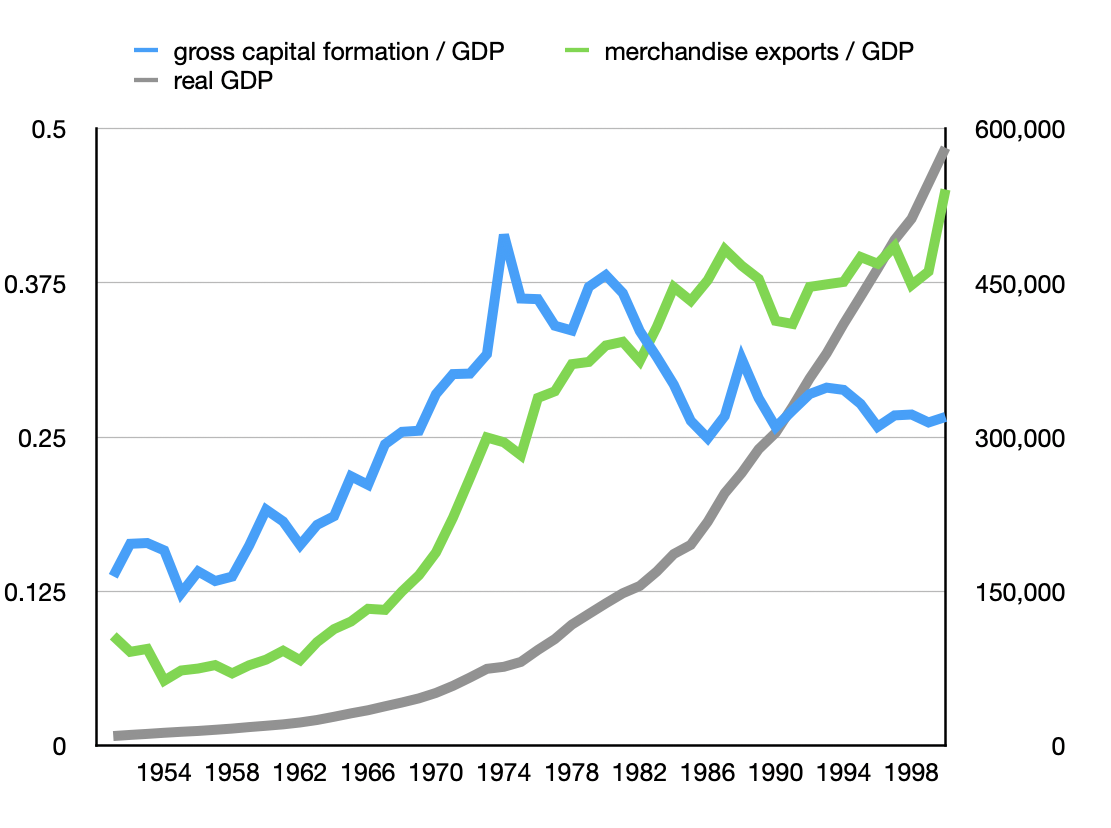
The figure below shows the shares of investment and merchandise exports in GDP (plotted against the left axis) and real GDP (plotted against the right axis) between 1951 and 2000.39 Investment’s share of GDP started to rise in the late 1950s, presumably to enable import substitution. In the early 1960s the share of merchandise exports in GDP began to grow rapidly. The investment share also grew more rapidly, presumably to enable export growth. Together, exports and investment drove the dramatic growth of Taiwan’s GDP.
Yin died shortly after the reforms were implemented, but another senior government official, Li Kwoh-ting, was able to appraise the reforms from the perspective of 1988. He wrote,
When the initial liberalization efforts were made, no one had any inkling that a more prosperous growth epoch was in the making. The early efforts were not ideologically motivated by any clear vision of the advantages of externally oriented growth, and there was only a vague awareness of the benefits of comparative advantage. The late 1950s reform measures were adopted for a pragmatic reason, namely, to reduce the reliance on American aid and to solve the problems of unemployment and foreign exchange shortages…The term “externally oriented growth” was coined by economists only after its epochal significance became apparent.40
Developing Export Industries
The freeing-up of the foreign exchange market did not imply a general abandonment of intervention: the government still intended to promote particular industries. It was already making plans for an export-oriented economy in the mid-1960s. A major planning document declared,
For further development, stress must be laid on basic heavy industries (such as chemical wood pulp, petrochemical intermediates, and large-scale integrated steel production) instead of end product manufacturing or processing. Industrial development in the long run must be centered on export products that have high income elasticity and low transportation cost. And around these products there should be development of both forward and backward industries, so that both specialization and complementarity may be achieved in the interest of Taiwan’s economy.41
There are several interesting things here. First, there was already an emphasis on capital-intensive heavy industry. Korea would not begin its own “Heavy and Chemical Industry Drive” until 1973, almost a decade later. Second, as in Korea, the need for new industries that provide backward and forward linkages was recognized. Third, Korea’s emphasis on scale was not to be found. The focus was instead on goods with “high income elasticities”: Taiwan would move up the value chain to high-margin goods.
The shift towards capital-intensive production caused a period of rapid investment. “Even in 1960, at the start of the export boom and not as a consequence of it, the rate of gross domestic investment to GDP stood at about 20 percent.”42
The share of manufacturing in GDP rose from 22% in 1960 to 37% in 1977. Within manufacturing, chemicals and machinery grew especially quickly: they constituted 24% of manufacturing value-added in 1961 and 50% in 1974.43
Not all of the growth was in heavy industry. Almost any firm that could export its output qualified for incentives of some sort, and the government undertook several measures to stimulate light industry. Export-processing zones, within which firms were exempt from quotas and duties, conditional on their exporting all of their output, were set up. The availability of cheap labour drew foreign firms to these zones. Industrial estates were also set up in areas where low-wage labour was still abundant. As a result,
Labour-intensive, export-oriented industries briskly multiplied, and the industrial sector quickly exceeded the agricultural sector in total output, employment and export, while private enterprises replaced state-owned enterprises as the core of manufacturing sector.44
The government’s interventions in heavy industry were ongoing and obvious. Its interventions in light industry, which was primarily populated by private firms, was more discreet but still evident. Does it follow, then, that “industrial policy” was responsible for Taiwan’s incredible growth? The answer is still in doubt due to several complicating factors.
The only precise way to measure the benefits of Taiwan’s industrial policy is to compare two histories of Taiwan: one with the policy in place, and one without it. But, obviously, we only know one of these histories — the one that actually happened. What we do know, though, is that factors external to Taiwan — factors that would have been in place in either history — were highly favourable to Taiwan’s economic growth. Trade expanded massively in the postwar period, allowing East Asia’s early industrializers — Japan, Korea, and Taiwan — to readily find foreign markets for their goods. As well, all three countries benefited from a brief period of “asymmetric trade”: less developed countries were given free access to the markets of the United States and some other western countries, even as they used tariffs and quotas to stifle imports into their own countries. This period lasted roughly three decades, from the end of World War II to the mid-1970s. Finally, all three countries benefited from the sale of goods to the American military during the Vietnam War. So Taiwan might have done quite well even without its industrial policy.
Many less developed countries were exposed to these same external factors but, leaving aside the city-states of Hong Kong and Singapore, the only ones that grew “faster for longer” were Japan, Korea, and Taiwan — the ones that avidly embraced industrial policy. The claim that industrial policy explains none of their extraordinary growth would seem to be as untenable as the claim that it explains all of it.
Industrial policy is often described as “picking winners and losers.” If this description were taken literally, the success of industrial policy would hinge upon the government being able to predict future economic trends better than competitive firms. There is little evidence that Taiwan’s government attempted to “outthink the market” in this way. It almost always accelerated trends or exploited opportunities that were already visible to the country’s entrepreneurs. Supporting the production of cotton textiles in a low-wage country, or the production of chemical fertilizer in a predominantly agricultural country, wasn’t a risky bet. Even the government’s move into semiconductors was a response to existing market trends.
High-Technology Exports
A rudimentary electronics industry existed in Taiwan even in the late 1940s, when radios were locally assembled from imported parts. In 1950 the government began to support the assemblers by restricting imports of whole radios. Local firms also produced simple goods like wire and light bulbs. Local production of “radios, fans, meters, fluorescent lights, low-voltage transmitters, and cables” soon followed. Attracted by Taiwan’s cheap labour, a number of Japanese firms contracted with Taiwanese firms for the assembly of electrical goods. In 1962 the government, recognizing the industry’s potential, intervened again.
The government imposed local content requirements for the production of televisions, refrigerators, air conditioners, automobiles, diesel engines, and several other items. These requirements meant that an escalating percentage of total value had to be made up of locally produced parts. This represented the government’s response to a calculation that much of the incoming Japanese investment gave low social returns, because it intended only to make items for sale on the domestic market with components shipped in from Japan (the tariff on assembled items being much higher than on components). At about the same time the government also revised the rules regarding foreign investment, to facilitate joint ventures and technical cooperation agreements with foreign firms.45
The new agreements were (again) predominantly with Japanese firms.
The electronics industry in Taiwan was producing basic consumer goods, but elsewhere, the industry was forging a revolution that would reshape the world. The first electronic computers, developed in the late 1940s, filled entire rooms. They used vacuum tubes as switches, and vacuum tubes were slow, bulky, fragile, short-lived, and power-hungry. The replacement of vacuum tubes, first with transistors and then with integrated circuits, made modern computing possible.
Transistors were developed in the late 1940s and the 1950s. They performed the switching function better than vacuum tubes, but were so difficult to produce that they only slowly replaced the older technology. Their first successful commercial application was a transistor radio manufactured by Sony. Offered for sale in 1957, more than seven million units were sold by the mid-1960s.
The next innovation came in the late 1950s: integrated circuits, popularly known as chips or semiconductors. They were produced by etching transistors and other electronic components onto the surface of a “chip” of semiconductor, usually germanium or silicon. A number of companies were involved in their development by the early 1960s. Their focus was on miniaturization and the attendant gains in speed and power efficiency.
The first microprocessor (Intel’s 4004) was released in 1971. It contained 2300 transistors on a base that measured 12 square milimeters. (By comparison, a 1950s transistor was the size of a “lady finger” firecracker, and a vacuum tube was the size of a salt shaker.) Microprocessors enabled the development of the personal computer in the 1970s and 1980s.
Miniaturization continued. A critical innovation was VLSI (very large scale integration) which allowed hundreds of thousands of transistors to be placed on a single chip. Intel’s Pentium Pro microprocessor, released in 1999, contained 5.5 million transistors. Another important innovation was application specific integrated circuits (ASICs). The early chips were purchased by users “off the shelf,” but by the 1980s, chips were being custom designed for specific uses.
Early semiconductor producers were highly integrated. They designed the chips, planned the production process and built the machinery needed to implement it, purified their own germanium and silicon, and produced, tested, and packaged the chips. The firms became less integrated as the industry developed, facilitating Taiwan’s entry into the industry.
The oil crisis of the late 1970s caused the Taiwanese government to shift its focus away from energy-intensive heavy industry, and to focus instead on such things as machine tools, semiconductors, computers, and telecommunications. The government recognized that Taiwan’s relatively small firms would not be able to undertake enough independent research and development to stay competitive, so it encouraged technology transfers from foreign sources. To this end, it established the Industrial and Technology Research Institute (ITRI) in 1973 — electronics was just one of its six branches. And it established the Hsinchu Science-Based Industrial Park in 1980. The park hosted collaborations between foreign and domestic firms; the government was prepared to take a 49% equity stake in spin-off projects.
ITRI moved into the production of semiconductors in 1977 by licensing RCA’s technology to produce an outdated (but still widely used) chip. ITRI’s factory was a success, with yields higher than RCA’s own.46 ITRI spun-off Taiwan’s first semiconductor company, United Microelectronics Corporation (UMC) in 1980. UMC was (and continues to be) successful, but as late as 1986, no Taiwanese firm could fabricate VLSI chips.
The presence of the Hsinchu Industrial Park induced many technically-minded expatriate Chinese to relocate to Taiwan. Some of them were chip designers, and three of these designers requested government assistance to build their own semiconductor fabrication plants. A “fabless” designer was in an awkward position: he had to contract his production to another designer — a competitor — and trust that this competitor would neither push the contracted production to the back of the queue nor steal the design.
ITRI was headed at this time by Morris Chang, who had twenty years of production experience with Texas Instruments, one of the industry’s pioneering firms. Chang recognized that the government could not afford to build three plants, and he knew that unit costs fell substantially as a plant’s production rose. He proposed that the government, rather than financing three individual plants, create a new manufacturing company that would work entirely on a contract basis. This company would do no design work of its own, to avoid suspicion that it was competing with its customers.
The government looked for a private sector partner, and found one in the Dutch company Phillips. The new company, Taiwan Semiconductor Manufacturing Corporation (TSMC), came into being in 1987, with financing from the government (which paid about half of the total cost), Phillips, and a few smaller private investors. Its first non-Taiwanese customer was Intel, and once Intel declared itself satisfied, other American and European customers followed. TSMC is now the world’s largest semiconductor foundry, producing some of the world’s most advanced chips. The contract model was so successful that some major semiconductor companies (including Nvidia, Qualcomm, and Broadcom) have chosen to remain “fabless.”
While TSMC is Taiwan’s most successful company, many other Taiwanese firms are internationally competitive in computers, telecommunications, and consumer electronics. Acer, ASUS, Foxconn, HTC, MediaTek, and D-Link are all Taiwanese companies.
- Samuel Ho, “The Development Policy of the Japanese Colonial Government in Taiwan, 1895-1945,” in Gustav Ranis, ed., Government and Economic Development (Yale University Press, 1971), p. 300. ↩
- Samuel Ho, “The Development Policy of the Japanese Colonial Government in Taiwan,” p. 301. ↩
- Alice Amsden, “The State and Taiwan’s Economic Development,” In Peter Evans, Dietrich Rueschemeyer and Theda Skocpol, eds., Bringing the State Back In (Cambridge, 2010), p. 79. ↩
- Samuel Ho, “The Development Policy of the Japanese Colonial Government in Taiwan,” p. 317. ↩
- Samuel Ho, “The Development Policy of the Japanese Colonial Government in Taiwan,” p. 311. ↩
- Wade, Governing the Market, p. 230. ↩
- Wade, Governing the Market, p. 230. ↩
- Wade, Governing the Market, p. 229. ↩
- Wade, Governing the Market, p. 233. ↩
- Wade, Governing the Market, p. 233. ↩
- Wade, Governing the Market, p. 233. ↩
- Alice Amsden, “Taiwan’s Economic History,” Modern China (1979), p. 345. ↩
- Amsden, “Taiwan’s Economic History,” p. 352. ↩
- Amsden, “Taiwan’s Economic History,” p. 357. ↩
- Amsden, “Taiwan’s Economic History,” pp. 357-8. ↩
- Wade, Governing the Market, p. 76. ↩
- Samuel Ho, “The Rural Non-Farm Sector in Taiwan,” manuscript, 1976, prepared for the International Bank for Reconstruction and Development, p. 47. ↩
- Samuel Ho, “The Rural Non-Farm Sector in Taiwan,” p. 54 and Table 17 for small plants, p. 56 for large plants. ↩
- Samuel Ho, “The Rural Non-Farm Sector in Taiwan,” pp. 35-7. ↩
- Sophia Wu Huang, “Structural Change in Taiwan’s Agricultural Economy,” Economic Development and Cultural Change (1993), p. 51. ↩
- Sophia Wu Huang, “Structural Change in Taiwan’s Agricultural Economy,” pp. 55 and 56. ↩
- Chen Tun-jen, “Transforming Taiwan’s Economic Structure in the 20th Century,” Chinese Quarterly (2001), pp. 24-5. ↩
- Wade, Governing the Market, p. 78. ↩
- Wade, Governing the Market, p. 82. ↩
- Wade, Governing the Market, p. 83. ↩
- Amsden, “Taiwan’s Economic History,” p. 369. ↩
- Wade, Governing the Market, p. 66. ↩
- Wade, Governing the Market, p. 66. ↩
- “Taiwan’s firms are typically highly leveraged in the sense that they depend more on borrowing than on equity capital. According to official figures, the ratio of corporate sector debt to equity was between 160 and 180 in most years between 1971 and 1980; which compares with figures of only 50 to 90 for Great Britain and the United States. But Taiwan’s ratio is much lower than Korea’s, whose corresponding figure was 310 to 380. However, the “true” Korean figure is probably much lower than its official value, especially because of complications introduced by Korea’s higher inflation rate and higher permitted rates of accelerated depreciation. One estimate puts the real Korean figure in the same order of magnitude as Taiwan’s official figure.” (Wade, Governing the Market, p. 160.) ↩
- Wade, Governing the Market, p. 77. ↩
- Wade, Governing the Market, p. 79. ↩
- Wade, Governing the Market, p. 80. ↩
- Irwin, “How Economic Ideas Led to Taiwan’s Shift to Export Promotion,” p. 2. ↩
- K. Y. Yin, quoted by Irwin, “How Economic Ideas Led to Taiwan’s Shift to Export Promotion,” p. 9. ↩
- Irwin, “How Economic Ideas Led to Taiwan’s Shift to Export Promotion,” p. 5. ↩
- Taiwan’s exporters had to accept the foreign currency prices determined by world markets. An overvalued domestic currency meant that the (fixed) foreign currency prices of their goods translated into smaller amounts of domestic currency, reducing their profits. ↩
- Irwin, “How Economic Ideas Led to Taiwan’s Shift to Export Promotion,” p. 10. ↩
- Irwin, “How Economic Ideas Led to Taiwan’s Shift to Export Promotion,” p. 12. ↩
- The data are from the Penn World Table, version 10.1, and can be downloaded here. ↩
- Li Kwoh-ting, quoted by Irwin, “How Economic Ideas Led to Taiwan’s Shift to Export Promotion,” pp. 20-1. ↩
- Excerpt from the Fourth Plan (1965-68). Quoted by Wade, Governing the Market, p. 87. ↩
- Wade, Governing the Market, p. 88. ↩
- Wade, Governing the Market, p. 88. ↩
- Chen Tun-jen, “Transforming Taiwan’s Economic Structure in the 20th Century,” Chinese Quarterly (2001), p. 30. ↩
- Wade, Governing the Market, p. 94. ↩
- The yield is the fraction of semiconductors produced that function as intended. ITRI’s yield was 70%, which was good at that time. ↩

